
What Are Aviator Signal Bots?
Signal bots are automated or semi-automated services that claim to tell the player what the next Aviator round will do. The delivery method varies.
- Telegram bots. The most widespread format. A bot posts a message seconds before a round: “Next crash: 3.40x. Safe cashout: 2.80x.” The player opens Aviator on a casino platform, places a bet, and follows the signal. Some channels run fully automated posting. Others have a person behind the account typing predictions manually.
- Discord servers. Same concept, different platform. A channel dedicated to “Aviator signals” with a bot posting predicted crash points. Some servers charge admission. Others are free but funnel members toward affiliate registration links.
- Aviator predictor app downloads. APK files that display predicted crash multipliers on screen while the game runs. Some sit in a separate window. Others attempt to overlay directly on the casino interface.
- Signal websites. Pages that update with a new “prediction” every few seconds. The number on screen changes. The player tries to match it with what happens in the actual game. The site runs ads, collects traffic, and in some cases asks for casino login credentials to “sync” predictions.
- Aviator hack live streams. Social media streams showing someone supposedly using a predictor in real time. The screen shows a game window and a prediction window side by side. The predictions “match” the results. The stream is either delayed, pre-recorded, or selectively edited. A download link in the description leads to a paid tool, an affiliate registration page, or malware.
How Aviator Signals Usually Work
The typical signal operation runs a simple cycle.
A Telegram channel or bot posts a prediction before a round starts. The prediction includes a crash multiplier and sometimes a “safe cashout” level below it. The player bets and tries to cash out at or before the predicted point.
If the round cooperates — if the actual crash point happens to land near the predicted number — the channel posts a success screenshot. Members react. New users see the win and believe the bot works.
If the round crashes early or the prediction misses by a wide margin, the message gets deleted within minutes. Or edited to show a different number. Or the miss gets blamed on “server delay” or “the casino detected the signal.” The failure vanishes from the record. The channel’s visible history shows only wins.
Some channels post five or six predictions at once and let probability handle the rest. On a low-volatility stretch, one or two of six might land close enough to look correct. Those become the headline. The four or five misses get cleaned up.
The more sophisticated operations rotate predictions across different Telegram groups with different names. Same operator behind all of them. If one channel builds a reputation for “accuracy,” it gets promoted. The others get abandoned. The operator starts fresh under a new name whenever the current channels accumulate too many complaints.
Why Signal Bots Look Convincing
The confidence trick works because of how the evidence is presented, not because of what’s behind it.
- Selective posting. Only winning signals stay visible. A channel that posts fifty predictions and deletes forty failures looks like it has an 80% success rate from the outside. The actual rate — including the deleted messages — is closer to random.
- Fake screenshots. Edited images showing enormous win amounts beside the bot’s prediction. The casino interface is real. The numbers are changed in an image editor. Unless the viewer opens the same round on the same platform and verifies the result independently, the screenshot is unverifiable.
- Social proof from planted accounts. Group members who respond with “Thanks! Just won $200 following the signal!” are often either the operator’s own accounts or paid participants. Real members who lost following the same signal tend to stay quiet or get removed from the group.
- Urgency and scarcity. “VIP signals available for only 20 more members.” “Price doubles tomorrow.” “Today’s accuracy: 94%.” The pressure to act fast reduces the time available for critical thinking. The player signs up or pays before the rational questions have a chance to form.
- Free trials that coincide with luck. A new member gets three days of free signals. If the game happens to produce a few rounds that land near the predictions by chance during those three days, the member converts to a paying subscriber. The trial period has nothing to do with signal quality. It’s a bet on variance — some trial periods will look good by accident.
Can Signal Bots Access Aviator Data?
No. The separation between a signal bot and the game’s data is absolute.
Aviator’s crash point is generated through Spribe’s provably fair system. The server seed is encrypted before the round starts. Client seeds from the first three bettors contribute to the final result. The crash multiplier is computed from these combined inputs. Until all inputs exist, the result doesn’t exist in its final form.
A Telegram bot runs on Telegram’s infrastructure. It has no API connection to Spribe’s servers. No authentication credentials. No data feed from the game backend. The bot cannot see the server seed. It cannot see the client seeds. It cannot see the crash point before the round ends because the crash point hasn’t been fully computed yet.
An aviator predictor apk installed on the player’s phone has access to what’s on the phone’s screen. It does not have access to what’s on Spribe’s server. Reading encrypted data from a remote server through a mobile app would require breaking the encryption — the same encryption class that protects banking and military communications. No $10 APK is doing that.
An aviator hack bot that claims direct server access is claiming something that, if true, would represent a major cybersecurity breach affecting every casino running Spribe games globally. That breach would be headline news. It hasn’t happened.
Common Types of Aviator Signal Scams
Paid VIP signals. The free channel is the funnel. The VIP group is the product. Access costs money — usually $20 to $100, sometimes in crypto for harder tracing. The VIP predictions are generated the same way as the free ones: randomly.
Aviator predictor hack download pages. Websites offering a tool that combines prediction with “server access.” The download contains either nothing useful or something harmful. The prediction feature is a frontend display generating random numbers. The harmful part runs in the background.
“100% win systems.” Not bots, but sold as strategy guides or courses. The system is usually a betting progression — double after a loss, halve after a win — that doesn’t change the mathematical expectation. The course fee is a guaranteed expense. The system’s results converge toward the house edge over time.
Subscription models. Monthly payments for ongoing signal access. Auto-renewal. The signals don’t improve from month to month because they were never connected to the game’s data. The subscription continues as long as the player believes, hopes, or forgets to cancel.
Fake AI Predictors and Scripts
The “AI” label is marketing. It doesn’t change what’s possible.
A neural network trained on historical Aviator results analyses data produced by a cryptographic random number generator. The generator is designed to produce outputs without patterns. Training AI on patternless data produces patternless predictions. The model outputs random numbers with high confidence, which is worse than useful — it’s misleading.
The AI also lacks the critical input: the server seed. Without it, the model is missing the variable that actually determines the outcome. Feeding an AI every previous crash point in Aviator’s history gives it exactly zero information about the next one, because each round generates its result from fresh cryptographic inputs independent of all prior rounds.
Scripts that claim to “read” the casino page’s source code face a similar wall. The crash point is not embedded in the page before the round starts. It’s computed server-side and revealed only as the round plays out. The page source contains the game interface, not the game result.
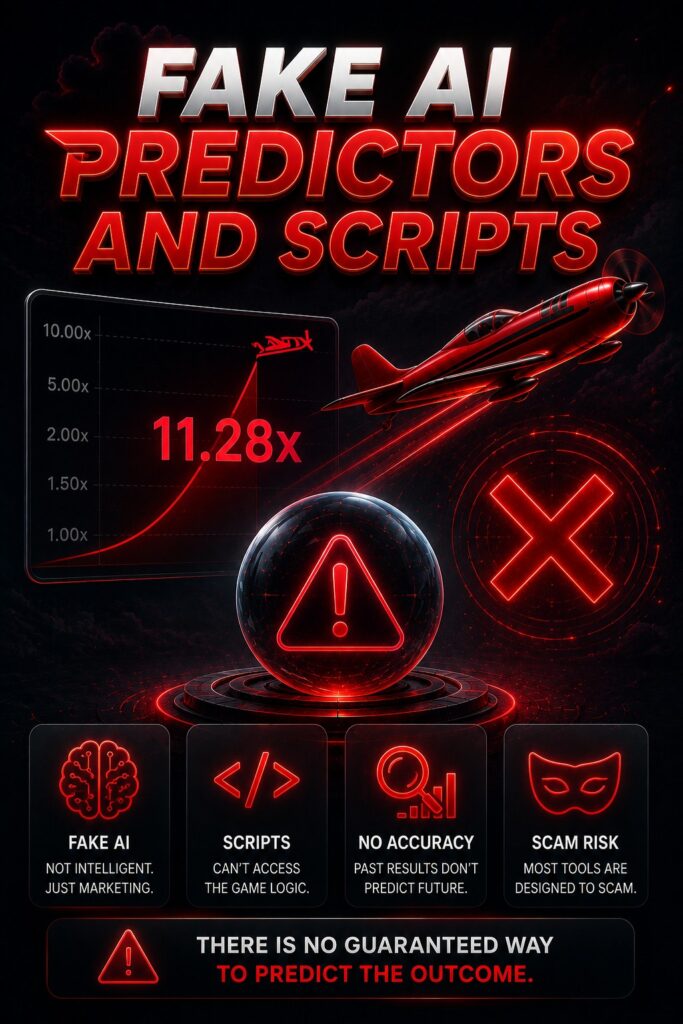
Risks of Using Aviator Bots
The financial risk splits two ways: money spent on the tool, and money lost following bad signals.
Tool costs are definite losses. Subscription fees. APK purchases. VIP group payments. None of these come with refunds when the predictions don’t work.
Following random signals in real-money play produces results statistically identical to playing without signals — minus the subscription cost. The house edge doesn’t change because a Telegram bot said “cash out at 2.10x.”
Security risks are separate and sometimes more damaging. Aviator hack apk files from unverified sources can contain keyloggers, credential stealers, clipboard hijackers targeting crypto addresses, and persistent background processes. An aviator predictor app that asks for casino login credentials is harvesting passwords. Account bans can follow from casino fraud detection picking up third-party tool interaction.
Why Players Keep Looking for Signals
Aviator’s format feeds the search.
Rounds are fast. A few seconds each. The pace creates a sense that something is about to happen. The multiplier climbs visually on screen. The plane gets smaller. The urgency is built into the animation. After a loss, the next round starts immediately. There’s no natural pause for reflection.
The near-miss effect hits hard. The plane crashes at 2.05x. The player had set cashout at 2.10x. Five hundredths of a multiplier separated a win from a loss. It feels like almost-right, not like random. The brain interprets the near-miss as evidence that the right answer was close, when in reality the result was generated without any connection to the player’s cashout setting.
After a losing streak, the emotional state shifts from entertainment to recovery mode. The player is no longer playing for fun. They’re playing to get back to even. In that state, a signal bot offering certainty feels like exactly the right tool. The critical question — “does this tool actually work?” — gets buried under the emotional need for it to work.
Safer Alternatives to Predictors
Disciplined play doesn’t promise wins. It shapes how the session feels and how long it lasts.
- Auto-cashout removes the hesitation. Set a modest target — 1.20x or 1.50x — and the system takes the money before emotion can intervene. The wins are small. They happen often at low targets. The consistency replaces the rollercoaster.
- Bet sizing at 1-3% of the session budget absorbs losing streaks without wrecking the balance. A ten-round losing streak at 2% per bet costs 20% of the budget. Uncomfortable but survivable. The same streak at 20% per bet costs everything.
- Stop-loss limits set before the first round define when the session ends. When the limit hits, close the game. The rule needs to be set in advance because mid-session judgement is compromised by the same emotions that make signal bots appealing.
- Demo mode exists for testing approaches without cost. Virtual credits absorb the variance. The observations carry into real play.
How to Spot a Fake Predictor
Guaranteed accuracy claims. Any service promising 90%+ hit rates on a cryptographically random game is either lying about its results or doesn’t understand the game’s architecture.
Hidden failure records. If a channel only shows wins and never acknowledges misses, the history is curated. Real performance includes both.
- Download requirements before access. A predictor that requires installing an APK or browser extension before showing signals is distributing software, not predictions. The software is the actual product. The prediction is the hook.
- Payment before proof. Paying for VIP access based on a free channel’s curated success screenshots is paying for marketing, not for performance. No verifiable track record means no basis for trust.
- Requests for casino credentials. No legitimate tool needs a player’s username, password, or wallet key. Any tool asking for these is collecting them for unauthorized use.